Procedures
Every procedure page explains what surgery actually involves.
Indications, technique in plain terms, what to expect before and after, recovery timeline in real ranges, and honest risk framing. Written to give you what you need to consent — properly informed — if surgery is the right step.
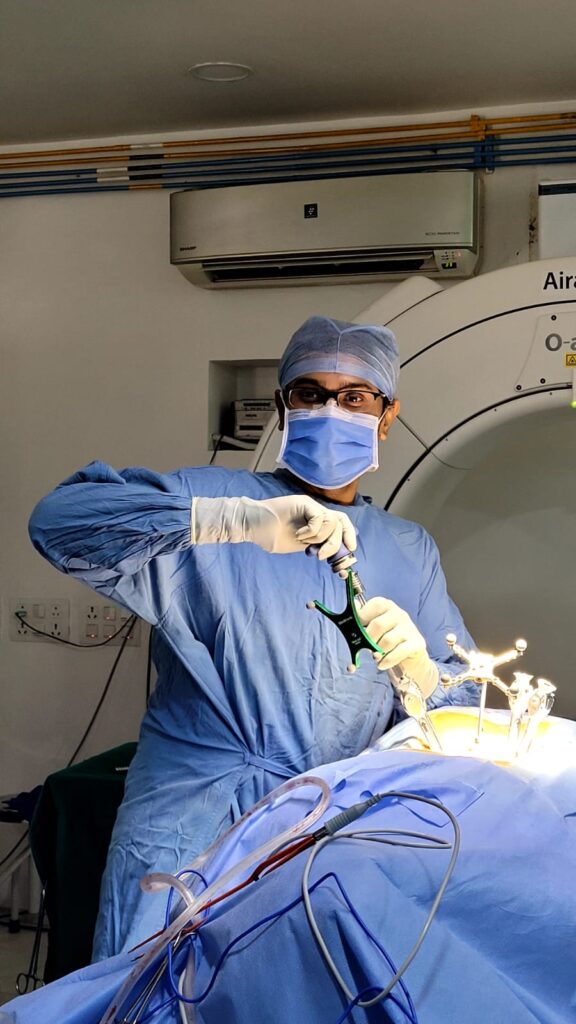
The techniques you'll see referenced across these pages.
Most of the procedures below are performed through small incisions using microscopic or endoscopic visualisation. Intraoperative navigation (the O-arm imaging system pictured here) allows real-time 3D verification of implant placement — most useful in cases where the margin for error is small.
- Minimally invasive tubular access, where anatomy permits
- Microscope- or endoscope-assisted decompression
- 3D-navigation-guided instrumentation for fusion cases
open
Anterior Cervical Discectomy and Fusion(ACDF)(ACDF)
Removes a damaged cervical disc from the front of the neck and stabilises the segment with a spacer and plate. First-line surgical option for many cervical radiculopathies.
→
endoscopic
Endoscopic Spine Surgery(Endoscopic Spine Surgery)
A minimally invasive technique that uses a small endoscope — a thin tube with a camera — to reach and treat spine pathology through an incision of about 8 mm. Best-suited to specific disc and stenosis pathologies where target anatomy is well-defined on imaging.
→
open
Laminectomy(Laminectomy)
Removes part of the vertebral bone (lamina) to relieve pressure on the spinal cord or nerves. The primary surgical option for symptomatic lumbar canal stenosis.
→
minimally invasive
Microdiscectomy Surgery(Microdiscectomy)
Microscopic removal of a herniated disc fragment that is compressing a nerve root. Small incision, typically 1–2 nights in hospital, early return to sedentary work.
→
open
Spinal Fusion Surgery
Joins two or more vertebrae to eliminate painful motion in a diseased segment. PLIF, TLIF and OLIF approaches are used depending on anatomy and pathology.
→
percutaneous
Vertebroplasty(Vertebroplasty)
Bone cement is injected through a needle into a fractured vertebra to stabilise it. Most often used for osteoporotic compression fractures with persistent pain.
→